More than Coach Training
Building Resilience from the Inside Out
Leader in ICF-Accredited Coach Certification for First Responders and Public Safety Leadership
Embedded. Certified. Sustainable.
At the Elias Institute of Professional Coaching we do not just train coaches—we deploy operational solutions.
We transform public safety cultures by equipping active personnel, veterans, and mental health professionals with rigorous, evidence-based frameworks to combat burnout, navigate trauma, and anchor long-term institutional health.
Our Programs at a Glance
Tailored for First Responder Agencies and External Support Organizations
Level 1 Approved Program: Associate Certified Coach (ACC) First Responder Resiliency Leadership® Coach Certification
The foundation of a coaching practice built for public safety. Our ICF Level 1 approved coach training program provides the core coaching competencies, ethics, and practical skills graduates need to apply for the ICF Associate Certified Coach (ACC) credential through the streamlined Level 1 application process.
The standard program includes one specialization: Resiliency Leadership® or Emotional Recovery for Crisis Response®. Through the Nationwide First Responder Resiliency Leadership Initiative, participants receive both specializations as part of the First Responder Resiliency Leadership Coach Certification—delivering an exceptional value and a significant tuition savings.
Level 2 Approved Program: Professional Certified Coach (PCC) Emotional Recovery for Crisis Response® Coach Certification
Built on Level 1 and designed to go further. Our ICF Level 2 program delivers comprehensive, advanced coaching training — including specialized focus in Resiliency Leadership, Emotional Recovery for Crisis Response, Stress Management, Group Coaching, and Organizational Wellness. Graduates qualify to apply for both the ICF Associate Certified Coach (ACC) and the Professional Certified Coach (PCC) credential, opening the door to the highest levels of coaching practice in public safety and beyond with our Command & Resiliency Leadership Coach® Certification program.
Diversify Your Practice with Professional Coach Certification & Enjoy Continuing Education
Whether you’re a therapist, counselor, social worker, or chaplain, professional coach certification opens a powerful new branch of service. Begin with our ICF Level 1 approved coach training program—the First Responder Resiliency Leadership Coach® Certification—and add the Emotional Recovery for Crisis Response® specialization to support first responders throughout their careers with a culturally informed, coach-centered approach that complements your professional expertise.
Continuing Education Programs & Advanced Certification
Build your expertise through continuing education in Resiliency Leadership®, stress management, group coaching, organizational wellness, and Emotional Recovery for Crisis Response®. Choose from monthly live events and advanced programs, including the Hardiness Resilience Gauge and Designing Transformational Coaching Programs.
For NBC-HWC certified coaches, enjoy the benefits of dual certification by adding one of our ICF Level 1 or Level 2 approved coach training programs to your professional portfolio—expanding your professional coaching skill set and opening the door to broader services, specialized programs, and increased earning potential.
Leader in Professional Coach Certification for Public Safety Leadership
Coaching Within a Profession. Building Leadership Capacity.Join
Announcing the Nationwide First Responder Resiliency Leadership Initiative
A Historic, Multi-Disciplinary Pilot Program Deploying Nationwide.
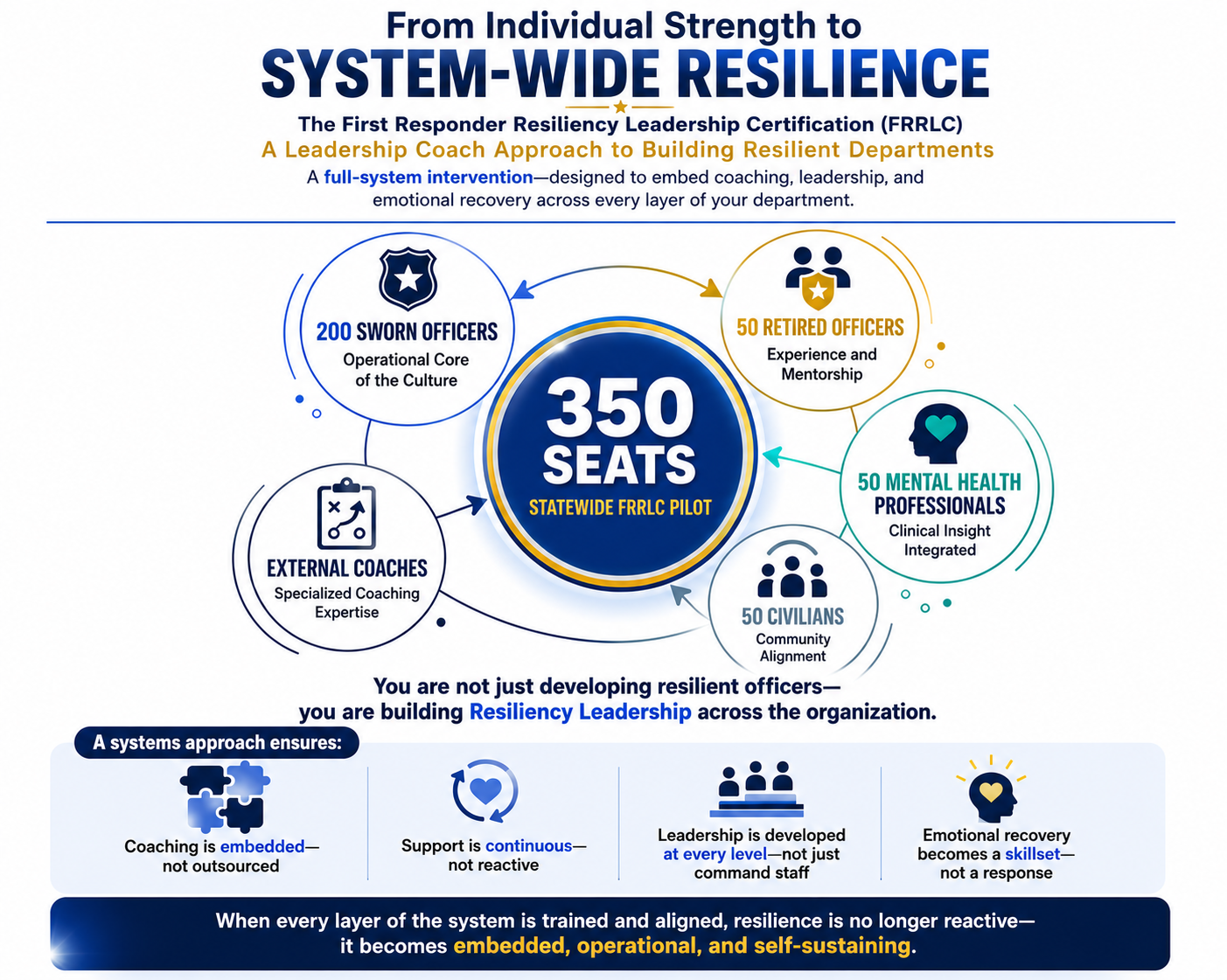
To address the compounding crisis in public safety mental health, the Elias Institute is launching an unprecedented nationwide pilot cohort. We are mobilizing 350 professionals across the country through an accelerated ICF Level 1 approved coach training program that uniquely includes both of our flagship specializations.
This multidisciplinary force is engineered to establish a self-sustaining national network—anchored in a leadership coach approach embedded within the department and reinforced by culturally informed external support and emotional recovery resources.
Legacy of Leadership
Every generation inherits the profession.
Few have the opportunity to help shape where it goes next.
Nationwide First Responder Resiliency Leadership Initiative
The first cohort only happens once.
Be among the pioneer leaders launching a new approach to public safety wellness.
A Multi-Disciplinary Mission for Systemic Change
- 200 Sworn Officers driving operational resilience from within their agencies.
- 50 Retired Officers anchoring peers with invaluable lived experience.
- 50 Mental Health Professionals merging clinical safety with action-oriented coaching.
- 50 Consulting Coaches navigating the unique nuances of first responder culture.
Resilient Departments Are Created by Leadership
This Initiative is built on a simple truth: lasting cultural change is not delivered through one-time training. It is built through the daily decisions, conversations, and example of leaders.
The Resiliency Leadership Protocol equips leaders to bring a leadership coach approach into the systems that shape department life every day. Through small, intentional shifts in how they develop personnel, address performance, guide difficult conversations, and respond under pressure, leaders build resilience from within.
Shape the Future of Public Safety Leadership
As a member of this inaugural cohort, you will help shape what comes next. Your experience, perspective, and direct feedback will inform the early development of the Nationwide First Responder Resiliency Leadership Initiative and help establish the foundation for every cohort that follows.
This is more than joining a program. It is an opportunity to help define a new leadership coach approach for public safety—one department, one leader, and one meaningful shift at a time.
350
Total Participants
Trained across four strategic cohorts
36
Months Duration
Comprehensive imitative timeline
85
Training Hours
ICF Level 1 Approved Program
Leadership Coach Approach to Building Resiliency
Supporting the Unique Needs of First Responders
First responders operate in continuous high-stress and crisis environments that create long-term mental, emotional, and physical strain. How leaders guide, support, and develop their people directly impacts an officer’s ability to perform, recover, and remain resilient over time.
A coaching-based leadership approach—supported by research and applied practice, including recommendations from Walter Reed National Military Medical Center—strengthens leadership effectiveness, supports emotional recovery, and helps close the resiliency training gap common in high-stress professions.
The Elias Institute of Professional Coaching delivers formal coach training and leadership development that embeds professionally trained coaches within the department—both as leaders using coaching skills and as dedicated internal coaches— creating a sustainable internal leadership capability that enables departments to develop their own people, strengthen officer wellness, and build resilience from within long after the initial training is complete.
Building Resiliency Leadership Capacity Supports Emotional Recovery
A Leadership Coach Approach to Fostering Emotional Recovery
First responders are repeatedly exposed to high-stress environments, critical incidents, social unrest, and natural disasters that create cumulative mental and emotional strain over the course of a career. Supporting long-term resilience requires more than helping individuals manage stress—it requires leaders who know how to foster emotional recovery as an ongoing part of everyday leadership.
Building this capability begins by providing leaders with formal coach training that equips them with the knowledge and skills to guide, support, and develop their people. As leaders apply these coaching skills throughout the department, they create an environment where first responders learn that emotional recovery is not about returning to who they were before the stressors of the job—it is about using the stressors of the job to become stronger, wiser, and better prepared for what comes next.
To support this approach, the Level 1 program introduces the foundations of Emotional Recovery for Crisis Response® alongside the Resiliency Leadership® specialization. For those who wish to expand their expertise, the ICF Level 2 Accredited program includes the full Emotional Recovery for Crisis Response® specialization, providing additional competencies, tools, and coaching strategies to support the ongoing emotional recovery of first responders.
350
Closing the Resiliency Training Gap with a Leadership Coach Approach
Over the Next 36 Months, Beginning January 2027
Our Ongoing Work:
From Leadership Philosophy to Measurable Results
Resiliency Leadership is more than a leadership philosophy—it is a practical, evidence-informed protocol designed to strengthen leadership capacity, support emotional recovery, and build resilient departments. By integrating transformational leadership, psychological hardiness, and formal professional coach training, leaders gain the competencies needed to implement sustainable systems that create measurable organizational change.
This is how we put that philosophy into practice.
Get Coached
Coaching is available through both formally trained internal leaders and external professional coaches, providing individuals and departments with access to the right level of support for their unique needs. Whether building leadership skills, navigating organizational change, supporting emotional recovery, or advancing professional goals, coaching offers a confidential, solution-focused approach that complements resiliency leadership, fosters emotional recovery, and supports wellness initiatives.
Leadership is Key
Resiliency Leadership transforms everyday leadership into a powerful force for building resilient departments. By integrating transformational leadership, psychological hardiness, and formal professional coach training, leaders strengthen leadership capacity, foster emotional recovery, and create the conditions where resilience can thrive.
A Leadership Coach Approach
A leadership coach approach transforms everyday leadership into an opportunity strengthen relationships, foster the exchange of ideas, and create a culture where people are supported, leaders are developed, and resilience becomes a natural outcome of everyday leadership.
Initiative Protocol Overview
First Responder Resiliency Leadership Coach Certification
A leadership coach approach to building resilient departments
Coaching Foundations & Resiliency Leadership:
Immerse yourself in a comprehensive exploration of foundational coaching skills, techniques, and practices. This module introduces the principles of formal coach training and resiliency leadership while demonstrating how coaching develops people, strengthens leadership, and helps translate learning into everyday action.
Coaching for Designing Actions:
Transform awareness into meaningful action through practical coaching strategies that help individuals move from insight to implementation. This module develops the knowledge and coaching skills needed to design sustainable actions, strengthen motivation, and support meaningful personal and professional growth.
Coaching for Emotional Recovery:
Building human capacity requires understanding how you make sense of and attach meaning to your experiences. Emotional Recovery uses cognitive processing principles and coaching techniques to help restore hope, renew purpose, and move forward following life’s most difficult experiences—not by returning to who you were before, but by carrying forward the knowledge and wisdom gained through adversity.
The Human Element in an Age of Artificial Intelligence
Historically, professional development, teaching/training, professional coaching and mental health support have been built upon human relationships. People working with people, listening, sharing experiences, building trust, and helping one another navigate life’s challenges. Today, technology is changing how these services are delivered, with artificial intelligence and chatbots increasingly being introduced as alternatives to traditional human interaction.
Artificial intelligence is a remarkable tool. It offers tremendous opportunities for learning, leadership development, problem-solving, and access to information. But as technology moves into spaces traditionally built around human relationships, it raises an important question:
What happens when we replace the human connection with a machine?
There are moments in life when information, advice, and even the most sophisticated technology are not what we need.
We need another human being.
Someone who can look us in the eyes and truly see us. Someone who can bear witness to our experiences, recognize our pain, share in our joy, and understand our grief. Someone who can sit with us through uncertainty, help us make sense of what we’ve experienced, and remind us that we don’t have to navigate every difficult moment alone. Someone who can hold the space for hope, help us look toward the future, and turn tragedy into triumph.
Technology has an important place in supporting brainstorming, gathering information, and structuring ideas. But when we move into the world of human relationships, making sense of and attaching meaning to our experiences, and crafting a vision for the future, technology should support—not replace—the human relationships, professional judgment, compassion, and connection that remind us we’re not in this alone, thus helping us move forward.
Technology is a tool. Human connection is our lifeline.
In Person
For learners who prefer the energy of an in-person classroom, our immersive learning experience combines hands-on coaching practice, personalized instructor feedback, peer collaboration, and meaningful professional connections that extend well beyond the classroom.
Virtual Programs
To meet the unique needs of our participants, we provide hybrid virtual programs that combine the flexibility needed for demanding professional careers with a highly interactive learning experience—without compromising engagement, feedback, or learning outcomes.